The Lean Toolkit for Local SEO That Most Pros Use
An industry veteran shares the raw proximity stack
The lean toolkit for local SEO consists of precise spatial tracking systems, manual profile integrity protocols, and targeted schema deployment strategies designed to win the local map pack without relying on bloated, automated software. Rather than wasting resources on massive platforms that ignore physical realities, elite local search engineers use focused instruments built specifically for location data verification. We focus on raw proximity metrics because Google processes user coordinates using deep distance-based calculation models that do not care about generic vanity metrics. Optimizing your presence requires understanding the exact signals that drive the local algorithmic engine.
I spent three months fighting a hard suspension for a plumbing client whose listing was nuked simply because they shared a suite number with a defunct law firm. Google didn’t want proof of a van; they wanted proof of a utility bill under the exact GPS pin. After weeks of automated rejections, I had to physically walk to the office building, photograph the physical directory in the lobby, and match those coordinates to the exact postal system records. That painful battle proved that local search is not about content creation; it is a brutal, physical validation process where search engines demand hard proof of real-world operations.
“Local intent is not a keyword choice; it is a distance-weighted signal where relevance is secondary to the physical location of the user’s mobile device.” – Map Search Fundamentals
The grid coordinates that define your revenue
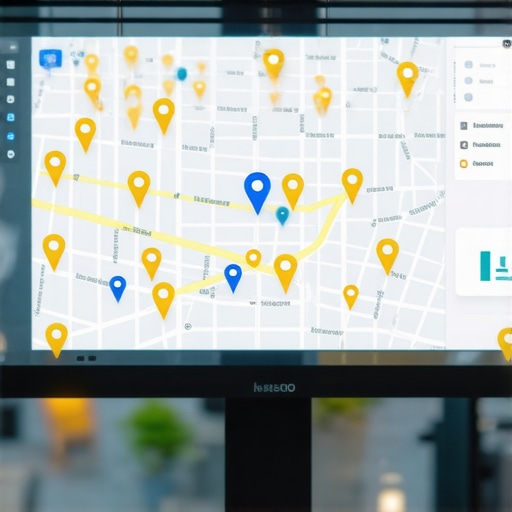
A business does not rank globally on maps but performs across a hyper-local grid of physical locations where every meter changes the competitive ranking. To master this landscape, search engineers use highly precise tools to turn your google business profile into a lead machine instead of relying on generic rank trackers. These spatial tracking tools place virtual searchers on a precise geographic grid to scan rankings every hundred meters. This tracking reveals how far your local reach extends before fading into competitor territory.
If you experience a sudden, geographic drop in your rankings, you are likely dealing with a regional authority loss. To diagnose this, search specialists deploy targeted the lean toolkit for local seo that most pros use to analyze competitor grid performance. Instead of panicking and changing your category settings, look at how the physical search origin points impact your visibility. You can use specialized local seo services to recover from proximity based ranking drop situations to rebuild your authority across those critical outer grid boundaries.
The pin moved. A single block can represent thousands of dollars in monthly service calls. Many businesses fail to realize that their physical location acts as a geographic anchor. When that anchor is weakened by technical issues, proximity alone cannot save your rankings. This spatial reality makes it vital to monitor your visibility on a neighborhood scale rather than tracking city-wide averages.
The silent destruction of secondary verification tiers
Local service listings often vanish from search results because of subtle, mismatched phone numbers, secondary verification conflicts, or hidden address issues that break local trust. If your secondary database does not align with your primary profile, Google’s automated systems will flag the location as high-risk. This mismatch is why we stress the importance of using professional the toolkit essentials for pro-level google business audits to clean up conflicting location data before it triggers a suspension.When listings are flagged, automated bots often make the situation worse by resubmitting bad data. Knowing stop using automated bots a safer way to rank your business profile is a critical step in preserving your authority. If you find your listing already suspended, you must follow a methodical restoration process. Following the strategy for restoring a suspended business profile will allow you to regain your map presence without losing your historical reviews.
“Proximity is the primary filter of the local search engine; relevance and prominence are secondary validation filters applied only after coordinate boundaries are satisfied.” – Vicinity Algorithmic Analysis
Do not let minor structural discrepancies destroy years of local credibility. A single incorrect digit in a citation or an outdated suite number can slowly erode your organic authority. Regular manual audits are the only way to catch these silent technical errors before they turn into hard suspensions.
The Local Authority Reading List
- Read our blueprint for recovery: The Strategy for Restoring a Suspended Business Profile
- Audit your software stack: The Lean Toolkit for Local SEO That Most Pros Use
- Fix your technical code: Why Broken JSON-LD Schema Is Making Your Business Invisible
- Recover from regional drops: Local SEO Services to Recover from Proximity Based Ranking Drop
- Stop automated mistakes: Stop Using Automated Bots a Safer Way to Rank Your Business Profile
The microscopic math of coordinate relationships
Every local business listing is treated as a single node within a wider spatial database where relationships to other business nodes dictate ranking. When an agency registers multiple spammy listings nearby, they crowd the local cluster. To combat this, search engine developers use advanced filters to demote overlapping listings. You can use high-performance tools to track and improve gmb rankings to pinpoint exactly which nearby listings are choking your organic reach.
Understanding how to use tools to rank your google business profile is about identifying these spatial obstacles. If your organic growth is blocked by artificial competitors, you need to use a dedicated gmb ranking toolkit for small business owners to monitor local density. When fake profiles crowd your target area, you must clean up your local market by targeting and removing duplicate listings.
Identify the noise. Clean up the cluster. The local search environment is a zero-sum game where a single spam profile on your block can push you out of the top rankings. By isolating your competitors and analyzing their physical location data, you can build a defensive moat around your business area.
The forensic footprint of your digital anchor
Your website is the primary authoritative source that backs up your physical map listing, and errors on your site will directly damage your maps performance. Many agencies focus solely on off-page citations while ignoring broken code on your primary landing page. If your site has technical issues, you should explore services to repair hacked or infected website for seo to restore clean communication with search crawlers.
In addition to cleaning your website, you must audit your backlink profile to avoid algorithmic penalties. If toxic links are holding your business back, professional seo services to fix toxic backlink profile can help you disavow dangerous associations. Over-optimized anchor text is another common issue that can lead to algorithmic demotions. Utilizing services to fix over optimized anchor text will help return your website link profile to natural, safe levels.If your listing is completely suspended due to toxic associations, you need specialized assistance. Expert seo services to recover from gmb suspension can help you present clean data to the search engineering teams. Rebuilding your organic foundation is the only way to secure a permanent spot in the competitive map pack.
The semantic markup that connects your platforms
Structured JSON-LD schema acts as a direct translation layer that connects your physical location to your brand profiles across the web. When search engines crawl your site, they look for nested schema markup that validates your name, address, and phone number. If this schema is missing or formatted incorrectly, search engines will struggle to associate your brand with your physical location. You can learn more about this by reading why broken json-ld schema is making your business invisible to repair these critical connection errors.
Your local search presence is built on consistent, structured verification. Modern search engines rely on machine-readable data to understand physical relationships, which is why your schema markup must be flawlessly maintained. By aligning your website code, primary map listing, and social profiles, you create a cohesive network that search engines can trust. Investing time in your underlying code is what separates top-ranking local businesses from those that struggle to appear on the map.